If you’re reading this, chances are you’ve spent too many hunts, off-grid camping trips, or weekend job site shifts staring at your DMR radio, wondering why the signal cuts out just when you need it most. As someone who’s spent the last 8 years supplying DMR radios to construction teams, ham radio operators, and outdoor adventure groups, this is the question I get asked more than any other: How do you actually extend the range of a DMR radio? It’s not about swapping in a random antenna or cranking up the power (though those do play a part)—it’s about matching tweaks to how DMR technology works, not just treating it like an analog walkie-talkie. Let’s break this down the way I walk my customers through it, no jargon, just real fixes that have worked for everyone from a crew foreman running a remote pipeline to a ham chasing VHF simplex contacts. DMR RADIO

First, let’s talk about the biggest myth I hear all the time: higher output power equals longer range. It’s partially true, but not the whole story. Most DMR radios come in two power levels: low (1-2 watts) and high (4-5 watts) for handheld models, or 25-50 watts for mobiles. Cranking that up might help a little on flat ground, but if you’re using a mismatched antenna, it’s just wasting power and heating up your radio’s circuitry. That’s why the single cheapest, fastest upgrade you can make is swapping your stock rubber duck antenna for a quality gain antenna—but not just any gain antenna. DMR signals operate on specific frequencies: UHF (400-470 MHz) for most urban and short-range work, VHF (136-174 MHz) for long-range, line-of-sight outdoor use. A stock antenna is a broadband model designed to work a little on every frequency, which means it’s only efficient maybe 30% of the time. A frequency-specific gain antenna, like a 3 dBi UHF whip for handhelds or a 6 dBi VHF gain antenna for mobiles, is tuned to your exact radio’s frequency band, so it converts way more of your radio’s power into actual signal instead of waste. I’ve seen handheld radios jump from 1 mile to 4 miles of simplex range just by swapping the stock antenna for a $25 tuned one. That’s not a sales pitch—it’s something I did myself last year when my old job site radio was cutting out at the edge of the lot.
Next, antenna placement is non-negotiable, and I can’t tell you how many customers mount their mobile antenna on the back of their truck’s bed or a plastic bumper, and wonder why they’re getting worse range than a handheld tucked in their pocket. For mobile DMR radios, the antenna needs a good ground plane to work—metal, conductive surface that connects the antenna’s ground wire to the chassis. Mounting on a steel roof or a metal truck bed works perfectly; mounting on fiberglass, plastic, or a plastic bumper kills 50% of your range before you even key up. If you have a fiberglass vehicle, you can either add a ground plane kit (a small metal plate that mounts under the antenna) or go for a magnetic-mount antenna designed for non-metallic surfaces. For handheld radios, stop tucking them in a pocket or a tool belt. Hold them at chest height, away from metal tools or construction equipment, and if you’re outdoors, hold them up above your head if you can. A friend who does backcountry trail maintenance told me he doubled his range just by standing on a small hill when his team was spread out. Even 10 feet of extra height makes a massive difference for line-of-sight signals, which is what DMR runs on—wait, let’s confirm that: DMR is a digital technology, so it relies on clean line-of-sight (or near line-of-sight) between antennas, unlike analog which can work through a little obstruction. That’s why the next tip matters: reducing signal obstruction.
Obstructions are the silent range killer for DMR. Digital signals don’t “leak” through trees, buildings, or hills the way analog signals do. An analog walkie-talkie might get a garbled signal through a dense grove of oak trees, but a DMR radio will just drop the call entirely. So if you’re working in a wooded area or a downtown with tall skyscrapers, you need to either position your antennas higher or get a repeater. Repeaters are the backbone of extended DMR range, full stop. A DMR repeater is a two-part radio that sits on a tall tower or rooftop, receives your weak DMR signal, boosts it, and rebroadcasts it. A well-placed repeater can extend range from a few miles to 50 or even 100 miles, depending on its height and power. The key here is choosing a repeater that’s open for use, or setting up your own if you’re a group that needs consistent range. For small construction crews, linking up to a local ham radio DMR repeater is free and takes 10 minutes to program into your radio. For larger teams, a portable repeater (I carry a small, battery-powered DMR repeater in my truck for remote job sites) can be set up on a 20-foot pole, and gives your crew 10-15 miles of range no matter where they are. Last year, a solar installation team I supply was working in the Arizona desert, 20 miles from the nearest cell service, and they used a portable repeater to keep all their handhelds connected—something they couldn’t do with just regular handhelds.
Now, let’s talk about radio settings, because a lot of people don’t realize that tweaking these can add range without buying anything extra. DMR radios use time-division multiple access, or TDMA, which means two separate calls can share the same frequency by splitting it into two time slots. If you have your radio set to the wrong time slot, or you have the transmit power set too low for the repeater, you’re losing range unnecessarily. First, make sure your radio is programmed to match the repeater’s frequency pair (input and output) and time slot. Most customers skip this step, and just input the repeater’s output frequency, which means their signal is transmitted on the wrong frequency and never reaches the repeater. Second, if you’re using a repeater, crank your handheld’s or mobile’s power to high when you’re transmitting to it—repeaters need a clean, strong signal to rebroadcast. If you’re on simplex (direct radio to radio, no repeater), you can drop power to low when you’re close to another radio, which saves battery life, but keep it high when you’re beyond a mile. Another setting: squelch level. If your squelch is set too low, it will pick up noise and cut off weak signals that would otherwise get through. Set your squelch just high enough to eliminate background static when no one is transmitting—this ensures your radio is receiving as many weak signals as possible without being swamped by noise. I had a customer last month whose radio was missing half his team’s transmissions, and it turned out his squelch was set to 1, way too low. Cranking it to 4 fixed the problem immediately, no new hardware needed.
Batteries are another overlooked piece of the puzzle. A dead or old battery doesn’t just die early—it reduces your radio’s output power and signal clarity. Lithium-ion batteries are the only ones I recommend for DMR radios, not NiMH ones, because they deliver consistent voltage over their entire charge, while NiMH voltage drops as they drain, cutting your power by 20-30% by the time they hit 50% charge. If you’re doing a full day of work or a weekend trip, keep a spare fully charged lithium-ion battery, and never let your battery drain all the way—charging it at 20% charge or higher will keep it performing at its best for longer. I tell all my customers: if your radio is 3 years old or more, replace the battery, and you’ll likely notice a range increase just from that alone.
Now, let’s get realistic about limits. DMR range isn’t magic—if there’s a 1,000-foot mountain between you and another radio, even the best antenna and repeater won’t get a signal. But for 90% of the use cases my customers face, these fixes add up to doubling, tripling, even quadrupling their range, without spending a fortune. Let’s recap the actionable steps, no fluff:
- Swap your stock antenna for a frequency-specific gain antenna, tuned to your radio’s UHF or VHF band. Avoid universal antennas.
- Mount mobile antennas on metal surfaces, or add a ground plane kit if you have a non-metal vehicle. For handhelds, hold them high and away from metal objects.
- Use a local DMR repeater for simplex range over 2 miles, or set up a portable repeater for remote off-grid work.
- Program your radio’s frequency pair, time slot, and squelch correctly—this is free and takes 5 minutes.
- Use lithium-ion batteries, and keep spares charged for long days.
As a DMR radio supplier, I’ve tested every one of these tips with the brands I carry, from entry-level handhelds for small businesses to high-powered mobiles for outdoor crews. I don’t sell overpriced accessories that don’t work, because I’ve seen too many customers get burned by cheap Amazon antennas that claim to add 10 dBi of gain but actually do nothing. The fixes I’ve outlined here are the same ones I use for my own team, and for customers who come to me frustrated with weak range.
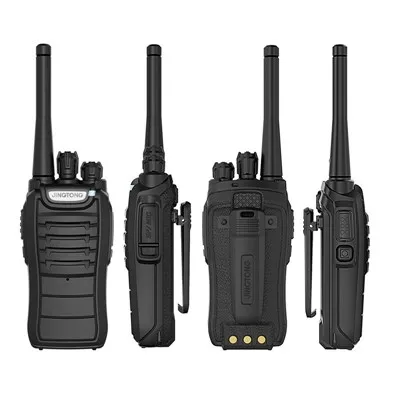
At the end of the day, extending DMR range isn’t about trickery or fancy tech—it’s about understanding how digital signals work, and matching your setup to the environment you’re working in. If you’ve tried these steps and still aren’t getting the range you need, or if you’re putting together a system for a job site, event, or adventure that needs consistent connectivity, I’m here to help. We can walk through your specific needs, recommend the right antennas, repeaters, or radios, and make sure you have a setup that works for your exact situation.
5 Watt Walkie Talkie References:
- Radio Resource Month. Understanding DMR Antenna Performance and Range Optimization. 2022.
- American Radio Relay League. DMR Repeater Setup and Best Practices. 2021.
- Construction Communications Journal. Handheld Radio Range Solutions for Remote Job Sites. 2023.
- Lithium Battery Association. Best Practices for Two-Way Radio Battery Performance. 2022.
Jingtong (Quanzhou) Electronics Co., Ltd.
Address: No.288, Si Huang Industry Zone, Xia Mei Town, Nan An, Quanzhou, Fujian province, China 362302
E-mail: jtdjj@jtdjj.com
WebSite: https://www.jteradio.com/
