Hey everyone, and welcome back to the blog! If you’ve ever spent any time in a warehouse or distribution center, you’ve probably seen those super tall, narrow forklifts zooming down aisles that are barely wide enough for them. No, I’m not talking about your standard sit-down forklift that takes up half the bay—those are narrow reach trucks, and as someone who’s been supplying these bad boys for over a decade, I get asked one question all the time: “How do these things even work? They fit in spaces smaller than my garage, yet they lift pallets 30 feet high without tipping over?” Narrow Reach Trucks
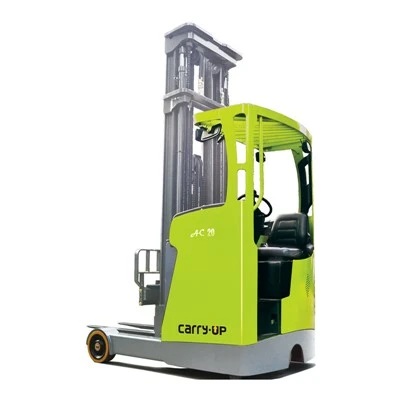
Fair question. A lot of people see a narrow reach truck and assume it’s just a regular forklift crammed into a smaller frame, but there’s way more going on under the hood (or, more accurately, under the operator compartment) that makes these machines work. Today, I’m breaking it down for you, no confusing jargon or techy fluff—just the real deal from someone who’s sold hundreds of these units to warehouses across the country.
First off, let’s clear up what a narrow reach truck actually is, because a lot of folks mix them up with order pickers or stand-up counterbalance forklifts. Counterbalance forklifts have that big metal chunk at the back to keep them from tipping when they lift heavy loads, right? Not narrow reach trucks. These are designed for super tight aisles—we’re talking 6 to 10 feet wide, vs. 12+ feet for standard forklifts—and their whole design is built around that narrow aisle goal. Most narrow reach trucks are stand-up or sit-down (I’ll get to the differences in a sec) and they have that iconic extending mast that moves forward, not just up. That’s key.
Let’s start with the core components, because once you understand the basics, the rest clicks. First, the chassis. This isn’t your average forklift chassis. It’s low to the ground, super rigid, and way narrower—like, as little as 3 feet wide for some models. Why low to the ground? Center of gravity, my friend. The lower you can keep all the heavy stuff (batteries, motors, hydraulics), the harder it is to tip over, even when you’re lifting tons of weight 30 feet in the air. We’ve had clients try to use regular forklifts in narrow aisles and they’ve had those scary tip-over incidents—narrow reach trucks eliminate most of that risk with the chassis design.
Next, the wheels. This is where the magic really happens for maneuverability. Most narrow reach trucks have three wheels: two drive wheels at the back, and one large, steerable wheel at the front, centered under the mast. Wait, some newer models have four wheels, but let’s stick to the standard for now. That single front wheel doesn’t just turn left or right—it can pivot almost 180 degrees, which lets the truck turn in its own width. No more needing to crank the wheel back and forth to make a tight corner. That’s how they fit in aisles that are half the size of standard forklift lanes. The tires are solid rubber, too—no air, because warehouses can be rough on tires, and flats are a hassle no one needs.
Now the part everyone stares at: the mast. That telescoping arm that extends out to grab pallets, lift them, and slide them into racking. Here’s the thing about narrow reach truck masts: they’re not just one long arm. Most are a two-stage or three-stage telescoping system, made of stacked metal sections that slide into each other with heavy-duty bearings. But unlike standard forklift masts that lift straight up, narrow reach truck masts have that extendable “reach” part. So you can drive the truck right up to a rack, slide the mast forward, grab the pallet, pull the mast back so the load is over the chassis, then lift it up high. That’s the big difference from counterbalance forklifts—no back end sticking out, no need for extra space to extend the mast backward. That’s how they work in aisles so narrow you can barely open a door in them.
Wait, let’s talk about that reach function, because it’s way more high-tech than it looks. The mast is operated by hydraulic cylinders, right? But the hydraulics here are precision-tuned. When you slide the mast forward, the system automatically adjusts the pressure to keep the load balanced. If you have a 2,000-lb pallet 10 feet out on the mast, the hydraulics don’t just push forward equally on both sides—they adjust to make sure the load stays centered, so the truck doesn’t lurch to one side. We’ve had clients test this with static weights, and even with the mast extended 3 feet out, the side-to-side tilt is barely perceptible. It’s not magic, but it feels like it sometimes.
Now, the operator’s station. A lot of new operators get intimidated by narrow reach trucks at first, but once they learn, they prefer them over regular forklifts. Most are stand-up models, which gives the operator a 360-degree view of the mast and the racks on both sides. The controls are super intuitive: a joystick for moving the mast (extending, retracting, lifting, lowering), another for steering, and buttons for speed adjustments. The best part? The speed and functions are all tied to load weight and height. If you’re lifting a light pallet 25 feet high, the truck will automatically slow down when you get near the top, to prevent sway. If you have a heavy load close to the ground, you can move a bit faster. That’s a safety feature we’ve pushed hard on, because warehouse accidents are no joke.
Oh, and the anti-tip system—you didn’t think I’d skip that, right? Even with all that design, a 30-foot mast with a heavy load is a recipe for a tip if something goes wrong. Narrow reach trucks have built-in tilt sensors all over the chassis. If the truck tilts more than a tiny angle (usually 2 or 3 degrees) when lifting a load, it will automatically cut power to the hydraulics so you don’t lift it further. There’s also a load sensor that detects how much weight is on the forks. If you exceed the truck’s weight limit (which is clearly labeled, by the way), it won’t let you lift it at all. No exceptions. We’ve had a few clients try to cram an extra pallet on top of a load, and the truck just beeps at them and locks up. Annoying at first, but it’s saved a lot of damage and injuries.
Wait, let’s clear up a common myth: narrow reach trucks can be used for long-distance moves, right? No, mostly not. They’re designed for racking in narrow aisles, so their top speed is usually around 5 or 6 mph, vs. 10 mph for standard forklifts. They don’t have big fuel tanks (most are electric, by the way—more on that in a sec) so you don’t want to drive them across a whole warehouse floor. They’re the workhorses for high-density storage areas, not for moving pallets from the loading dock to a staging area. That’s an important distinction, because I’ve had customers call me asking if they can use a narrow reach truck for general tasks, and when I say no, they get confused. Stick to their lane, and they’re unbeatable.
Speaking of electric: almost all narrow reach trucks are battery-powered. You might be thinking, “What about the big battery? Won’t that make the truck too heavy?” No, actually. The battery is mounted low in the chassis, right over the drive wheels, which helps with that center of gravity I mentioned earlier. Lead-acid batteries are common, but we’ve been pushing lithium-ion models lately—they charge faster, last longer, and don’t have that messy electrolyte leak if the battery gets damaged. Most warehouses can swap out a lithium-ion battery in under 10 minutes, so downtime is minimal. That’s a game-changer for 24/7 operations.
Now, let’s talk about the tech side that most people don’t see: the control system. Modern narrow reach trucks have microprocessors that manage everything from steering sensitivity to load balancing. If you’re turning the wheel at a high speed, the microprocessor will reduce the power to the drive wheels so you don’t skid in the aisle. If you’re lifting a load, it will adjust the hydraulic pressure in real time to keep the mast from swaying. Some even have IoT features now—you can track the truck’s usage, maintenance needs, and operator safety stats from a dashboard. We’ve had a few big retail clients add those, and they’ve cut maintenance costs by almost 20% because they can fix small issues before they become big ones.
Wait, let’s use a real example to make this make sense. Last year, we sold a fleet of 15 narrow reach trucks to a beverage distributor in Chicago. Their old standard forklifts were taking up 20% of their warehouse space, because their aisles were so wide. They switched to narrow reach trucks, and they were able to add 30% more pallet racking in the same space. The first time their operators used them, they called me panicking—said the mast swayed a lot when they lifted full cases of soda. Turns out, they were extending the mast too far out before lifting. We walked them through adjusting their workflow: instead of extending the mast first, they’d drive up to the rack, grab the pallet, pull the mast back so the load was tight against the truck, then lift. No more sway, no more issues. That’s the thing about narrow reach trucks—they work great if you adjust your workflow, not just swap in a new machine.
A lot of new operators also worry about visibility. The mast is right in front of you when you’re lifting, so can you see where you’re putting the pallet? Modern models have open masts, so you can see through the stacked metal sections, or cameras that mount on the mast to give you a feed on the operator screen. We usually recommend cameras for taller lifts (over 20 feet), because even the best open mast can make it hard to see a pallet at the top of a rack. It’s a small add-on, but it’s made a huge difference in reducing dropped loads.
Now, let’s get to the stuff that matters for anyone considering buying one: when do you need a narrow reach truck? If your warehouse has aisles 10 feet or narrower, if you’re storing pallets over 15 feet high, if you need to maximize storage space without expanding your warehouse, these are the trucks for you. They’re not cheap—way more than a standard stand-up forklift—but the ROI is insane when you look at the extra storage space you gain. Most of our clients pay for the trucks in under 2 years just from the extra pallets they can store.
Wait, I should mention the different types, too, just to cover all bases. There’s the sit-down narrow reach truck, which is good for longer shifts because operators don’t have to stand the whole time. Stand-up models are lighter and more maneuverable, so better for super tight aisles. There’s also the double-reach truck, which has two masts, so you can reach pallets on both sides of the aisle without turning the truck around. That’s perfect for 9-foot aisles, where turning would be tight.
Common mistakes I see new owners make: overloading the truck (don’t do it—even if it feels like it can hold more, the sensors will lock you out, but you risk damaging the mast), not doing regular maintenance (we recommend checking the hydraulic lines and wheels every 500 hours, which takes 15 minutes per truck), and training operators properly. A narrow reach truck is different from a regular forklift, so you can’t just throw an operator who’s only driven standard equipment on it for an hour. We offer free training sessions for all our clients, because bad training is where most accidents happen.
Let’s circle back to the original question: how do they work? At the end of the day, it’s all about balance, precision, and design. Low center of gravity, tight steering, telescoping mast that moves the load over the chassis, and smart safety features that adjust in real time. It’s not just a forklift in a smaller box—it’s a purpose-built machine that solves a specific problem: maximizing storage space in warehouses with limited aisle width.
If you’re reading this and you’re tired of wasting warehouse space on wide aisles, or you’re dealing with constant tip-overs and dropped loads with your current forklifts, narrow reach trucks are worth every penny. We’ve been supplying these for years, and we’ve seen clients go from cramped, inefficient warehouses to smooth, high-density operations that actually make money.
If you’re ready to chat about your specific needs, whether you’re a small warehouse with 10,000 sq ft or a big distribution center with 100,000 sq ft, hit us up. No pressure, just real advice about what works for your space and your workflow. No pushy sales stuff, just the kind of help we’d want if we were in your shoes.
Hand Pallet Trucks References:
- Material Handling Industry of America. (2022). Narrow Aisle Truck Design and Safety Standards. MHIA Press.
- Industrial Truck Association. (2023). Narrow Reach Truck Performance and Application Guide. ITA Technical Report.
- Warehouse Education and Research Council. (2021). High-Density Storage Solutions: Narrow Reach Truck ROI Analysis. WERC Journal of Logistics.
- OSHA. (2022). Powered Industrial Truck Safety Requirements: Narrow Aisle Equipment. Occupational Safety and Health Administration.
- Toyota Material Handling. (2023). Modern Narrow Reach Truck Technology and Control Systems. Product Engineering Whitepaper.
Hangzhou Carry Equipment Co., Ltd.
Hangzhou Carry Equipment Co., Ltd. is one of the most professional narrow reach trucks manufacturers and suppliers in China, also supports customized service. Please feel free to buy advanced narrow reach trucks for sale here and get quotation from our factory. For price consultation, contact us.
Address: No.360 Tongxiang Rd., Yinzhou Economic Development Zone, Yinzhou Dist., Ningbo, China
E-mail: Sales@carryupmhe.com
WebSite: https://www.carrymhe.com/
